

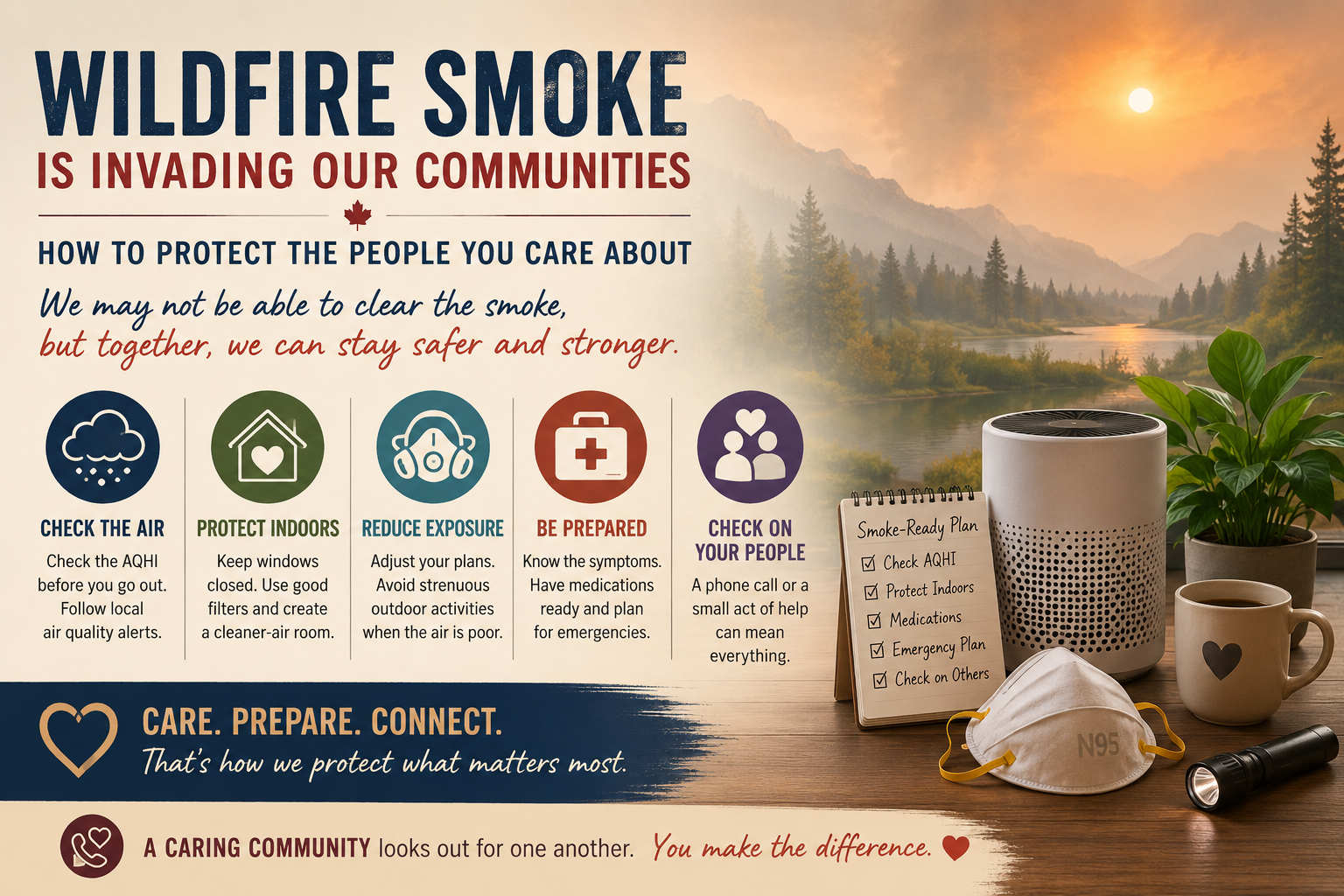
Wildfire Smoke Is
Invading Our Communities
How to Protect the People You Care About
Wildfire smoke can leave us feeling as though there is little we can do.
We cannot control the wind, put out a distant fire, or clear the sky on command.
We can, however, protect our homes, adjust our plans, pay attention to our health, and care for the people around us.
That matters right now.
Smoke from wildfires is moving through communities across North America. The fires may be hundreds or even thousands of kilometres away, yet the smoke can still reach our front doors.
Perhaps you have stepped outside and noticed that unmistakable campfire smell when there was no fire nearby. Maybe the sky looked grey, the sun appeared orange, your throat began to hurt, or your eyes began to sting.
For many of us, this is not how we recall summer. We think of open windows, gardening, golf, camping, family barbecues, long walks, and evenings on the patio.
Then the smoke arrives, our plans change, and we find ourselves asking:
What can we do to protect ourselves and the people who count on us?
Sometimes that care begins with a simple question:
“Are you all right, and is there anything you need?”
The Part of Wildfire We May Not See
Wildfire smoke contains gases, water vapour, and very small particles. The greatest health concern is fine particulate matter known as PM2.5.
These particles are invisible to the human eye and can travel far into the lungs. Air quality may be unhealthy even when we cannot see or smell smoke.
Some people face a greater risk, including:
- people age 65 and older
- infants and young children
- pregnant people
- people who work or exercise outdoors
- people living with asthma, COPD, heart disease, diabetes, or other health conditions
- people without reliable access to cooler, cleaner indoor air
During heavy smoke, anyone can be affected.
Health Canada’s wildfire smoke information:
https://www.canada.ca/en/services/health/healthy-living/environment/air-quality/wildfire-smoke.html
Listen to What Your Body Is Telling You
Milder symptoms may include:
- sore, burning, or watery eyes
- irritation of the nose, throat, or sinuses
- headache
- coughing or increased mucus
- unusual tiredness
More serious symptoms may include wheezing, chest pain, a severe cough, shortness of breath, dizziness, an asthma attack, or heart palpitations.
Pay attention to how you feel. Contact a health care provider when symptoms are concerning. Call 9-1-1 when a medical emergency is suspected.
Your Smoke-Ready Plan
A little preparation can make a smoky day safer and less stressful, particularly when families, friends, and neighbours are looking out for one another.
- Check the Air Before Going Out
Check the Air Quality Health Index, known as the AQHI, and follow local air-quality warnings.
Do not rely only on what you see through the window. The air may be unhealthy even when the sky looks fairly clear.
The AQHI uses a scale from 1 to 10+. A reading above 10 represents a very high health risk.
The WeatherCAN app can also provide air-quality forecasts and alerts.
- Adjust Your Outdoor Plans
Do you really need to mow the lawn, take that long walk, or finish the gardening today?
During smoky conditions, move strenuous activities indoors, shorten your time outside, or postpone them until the air improves.
Give yourself permission to change the plan.
There will be another day for the garden.
- Protect the Air Inside Your Home
Keep windows and doors closed when the temperature inside remains safe.
Use the highest-quality filter your heating or ventilation system can accommodate, following the manufacturer’s instructions. A portable air cleaner can also reduce fine particles in the room where it is operating.
When possible, set air-conditioning and vehicle ventilation systems to recirculate indoor air.
- Create a Cleaner-Air Room
Choose one room where household members can spend time when the smoke is heavy.
Close the windows and door, and run a portable air cleaner suited to the size of the room.
Add drinking water, medications, a phone charger, books, games, and anything else that may help people feel comfortable.
This space can be especially helpful for someone living with asthma, COPD, heart disease, or another condition that may be aggravated by smoke.
- Avoid Adding More Particles Indoors
Smoking, candles, incense, frying, broiling, and vacuuming without suitable filtration can add particles to indoor air.
Postpone these activities during a smoke event whenever possible.
Even the cozy candle may have to take the evening off.
- Wear the Right Respirator
When you must go outdoors, a well-fitting N95, KN95, or KF94 respirator may reduce exposure to fine smoke particles.
Cloth face coverings, loose medical masks, scarves, and face shields do not offer the same protection from PM2.5. Respirators also do not filter the gases found in wildfire smoke.
Some people with heart, breathing, or other health concerns may find respirators difficult to wear. Speak with a health care provider when you are unsure whether one is suitable for you.
- Put Heat Safety First
Wildfire smoke and extreme heat can arrive at the same time.
Closing every window may help keep smoke outside, but an overheated home can quickly become dangerous.
Use air conditioning when available. When your home becomes too hot, go to a cooler place with cleaner air, such as a community centre, library, shopping centre, public cleaner-air space, or the home of someone you trust.
(https://www.canada.ca/en/health-canada/services/publications/healthy-living/combine-wildfire-smoke-heat.html
- Prepare Medications and an Evacuation Plan
Keep an adequate supply of prescribed medications nearby.
When someone in your household has asthma, COPD, heart disease, or another condition that may worsen during smoky weather, speak with their health care provider about what to do if symptoms appear.
Follow local fire and evacuation alerts. Have identification, medications, contact information, pet supplies, and transportation arrangements ready.
When authorities tell you to evacuate, leave promptly.
Check on Your People
Wildfire smoke affects entire communities, but not everyone has the same ability to respond.
Who in your circle lives alone?
Who may have trouble hearing an alert, operating an air cleaner, collecting medications, arranging transportation, or reaching a cooler place with cleaner air?
Perhaps it is an older neighbour, a friend with breathing difficulties, a family member without air conditioning, or someone who does not follow local news and weather reports closely.
A familiar voice can bring comfort and reassurance.
A phone call may be all that is needed:
“I was thinking about you. Are you doing all right?”
Sometimes practical help is needed too. You might offer a ride, pick up a prescription, share an N95 respirator, help set up an air cleaner, bring over groceries, or invite someone into your cooler home.
These gestures may feel small to the person offering them. To the person receiving them, they may mean everything.
While we cannot clear the smoke, we can make sure no once faces it alone.
Rhonda Latreille, MBA, CPCA®
Founder & CEO
Age-Friendly Business®
p.s. Since 2003, Age-Friendly Business® has trained thousands of professionals and businesses committed to learning how to elevate the quality of the client, customer, and community experience. They are called Certified Professional Consultants on Aging (CPCAs)® and Age-Friendly Businesses®. They have earned the right to ask for your business.
Body
What Wildfire Smoke Can Do to the Body
Wildfire smoke can affect the eyes, airways, lungs, heart, and circulation.
Health Canada reports strong evidence connecting short-term exposure with respiratory problems, including worsening asthma and COPD. Exposure has also been associated with premature death, and there is some evidence of cardiovascular harm.
Research into repeated or prolonged exposure is still developing. Scientists are studying possible connections with cancer, neurological effects, reproductive health, and other conditions, but many long-term findings remain uncertain.
The practical response is to reduce exposure whenever possible, especially during repeated or prolonged smoke events. People with heart or respiratory conditions should keep medications available and follow the plan prepared with their health care provider.
Spirit
“Alone we can do so little; together we can do so much.”
This link points to an external review of mobile-focused online casinos for Australian players that discusses platform compatibility and common game types: best mobile online casino australia picks. The article outlines typical mobile features, deposit and withdrawal options, and differences between browser and app play. It may be useful to Australian readers weighing mobile performance and payment methods when choosing a site.
Helen Keller
0 Comments