

Who Sits at the Edge of Your Thanksgiving Table
Thanksgiving Table
Years ago, I had my hair done at a small salon. There were only two hairdressers, the owner and one other stylist. I tried to arrange my hair appointments on the same day and time.
And that is how I came to notice Doris.
Doris was an older woman who was often there when I arrived. Her hair would already be coiffed and looking lovely, yet she wasn’t heading for the door. She stayed.
Doris had experienced a stroke. What caught my attention, though, wasn’t her hair.
It was lunch.
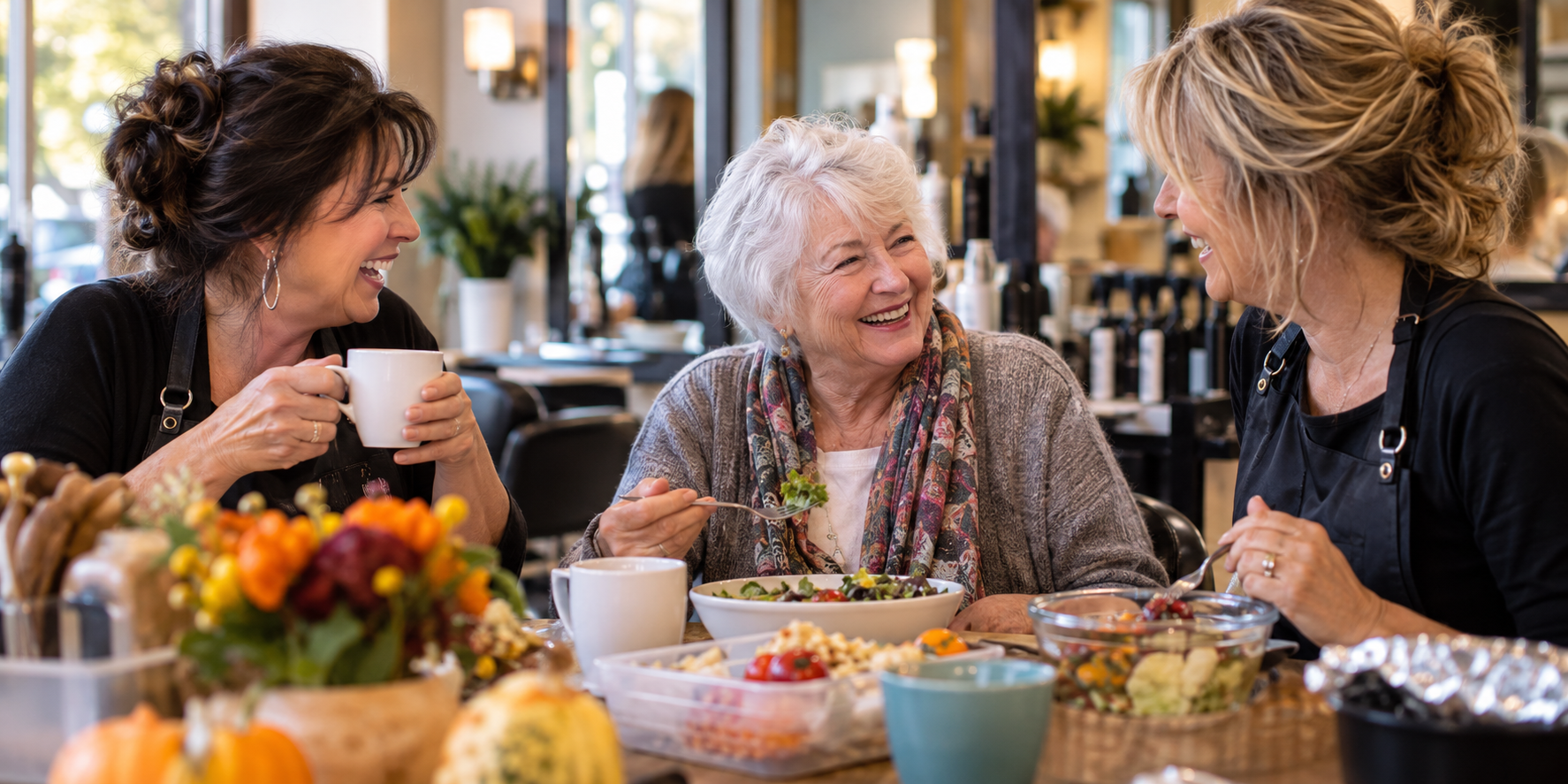
The two hairdressers brought their lunches from home and would prepare a plate for Doris from what they had brought for themselves. She would sit with them, eat, chat, laugh, and spend a good portion of the day at the salon.
I witnessed this on several occasions.
There was no fanfare. No program. No one called it community outreach.
There was simply a chair, some lunch, conversation, warmth and the unmistakable sense that Doris belonged there.
Much later, I arrived for an appointment and noticed that Doris wasn’t there. I asked about her.
Sadly, she had passed away.
Her family had contacted the hairdressers to tell them. They also invited these two women to attend and share in the celebration of Doris’s life.
I have never forgotten that.
Perhaps We Have Made Community Too Complicated
When we hear the word community, we might picture our neighbourhood, family, faith group, service club or circle of friends.
Researchers offer another interesting possibility.
They call certain gathering spots “third places.” Home is our first place. Work has traditionally been our second. Third places are the informal places where people meet, interact and spend time.
A 2022 review in The Gerontologist examined 32 studies involving older adults and identified community facilities, green spaces and local businesses as possible third places. The examples included cafés, markets, barbershops and, yes, beauty salons. The researchers found that convenient, comfortable local places were often associated with social interaction, although they also acknowledged that further research is needed. (https://academic.oup.com/gerontologist/article/63/7/1149/6895515)
Doris had found a third place.
Perhaps you have one too.
The coffee shop where they know your order. The pharmacy where someone asks about your spouse. The library where you recognize the same faces. The dog park. The pickleball court. The little restaurant where someone notices you haven’t been in lately.
We might think of these relationships as pleasant but peripheral.
Research suggests we shouldn’t dismiss them so quickly.
University of British Columbia researchers Gillian Sandstrom and Elizabeth Dunn studied our interactions with “weak ties,” the acquaintances who sit outside our closest circles. Their research found an association between these everyday interactions and greater happiness and feelings of belonging. (https://journals.sagepub.com/doi/10.1177/0146167214529799)
Some of the people contributing to our sense of belonging may never sit at our Thanksgiving table.
From Being Thankful to Being Someone Worth Thanking
Thanksgiving naturally turns our thoughts toward gratitude.
Who am I thankful for?
It’s a lovely question.
This year, I wonder what might happen if we added another.
For whom am I helping create a place of belonging?
Suddenly, gratitude asks something of us.
Who feels welcome because you are there? Who gets greeted by name? Who is invited into the conversation? Who might feel noticed because you noticed?
And who does that for you?
Does Your Favourite Business Understand the Magic?
Now consider the professionals and businesses you visit regularly.
They may believe they provide financial advice, cut hair, serve coffee, sell insurance, offer health services or prepare tax returns.
Perhaps they are also creating something they don’t fully recognize.
Community.
Think about a business you genuinely enjoy visiting. How do you feel when you walk through the door?
Are you recognized?
Does someone know your name?
Do they seem genuinely pleased to see you?
Do you feel like a person rather than the next transaction?
As we age, familiar places and familiar faces can acquire new significance. Retirement may alter workplace connections. Friends move. People we love die. Health or mobility can change our routines.
No business can or should replace family and close friendships.
Yet a business can become a place where someone feels known.
That is an extraordinary opportunity.
Age-Friendly Businesses® and Certified Professional Consultants on Aging (CPCAs)® understand that excellent service begins with seeing the whole person standing in front of you. Perhaps one measure of truly age-friendly service is wonderfully simple.
How do people feel when they are with you?
Who Is Your Doris?
This Thanksgiving, perhaps we can look beyond the people gathered around our own tables.
Who sits at the edges of our lives?
Who do we see regularly without realizing they have become part of our community?
And where might we be part of someone else’s community without even knowing it?
Years later, I cannot tell you what Doris ate for lunch. I don’t recall how her hair was styled.
I recall something far more lasting.
She had a place where she was expected.
She had people who were happy to see her.
She had a chair. She had lunch.
She belonged.
Perhaps community begins exactly there.
Warmly,
Rhonda Latreille, MBA, CPCA, Founder & CEO, Age-Friendly Business®
p.s. Since 2003, Age-Friendly Business® has trained thousands of professionals and businesses committed to learning how to elevate the quality of the client, customer, and community experience. They are called Certified Professional Consultants on Aging (CPCAs)® and Age-Friendly Businesses®. They have earned the right to ask for your business.
BODY
A Little Connection Can Do a Body Good
There is another reason to pay attention to community. Our social lives and our health are connected.
Research from the Public Health Agency of Canada examined adults age 65+ during the COVID-19 pandemic and found that loneliness was associated with lower measures of positive mental health, including life satisfaction and community belonging. Interestingly, the research also reminds us that living alone and feeling lonely are not the same thing.
Connection doesn’t require a packed calendar.
Chat with the neighbour. Call an old friend. Say hello to the person you see every Tuesday. Linger for that extra conversation after an appointment.
Small encounters can matter.
Doris might have agreed.
SPIRIT
Better Together
“Alone we can do so little, together we can do so much.” Helen Keller
0 Comments