

Have We Turned Healthy Aging Into a Competition?
When the Pursuit of Longevity Starts Competing With the Joy of Living Now
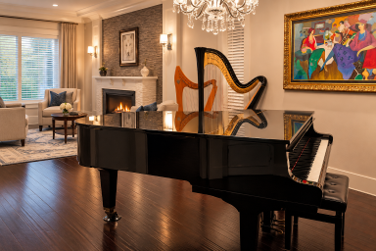
Just the other day, a friend asked me why I hadn’t returned to playing my harp and piano.
“Why don’t you just start playing again? Just for the enjoyment!” he suggested.
His comment took me back many years, to a particularly demanding, yet rewarding time in my career. A psychologist and close friend I worked with asked me what was missing in my life.
Easy. I missed my music.
“How much time would it take?” he asked.
“Probably three or four hours,” I replied.
“Well, surely you can find three or four hours a week!”
“Oh no! That’s three or four hours a DAY!”
“Good grief! You’re not trying out for the Vancouver Symphony Orchestra!”
We laughed. But I was genuinely puzzled. I didn’t know how to approach my music without the daily commitment to finger exercises, technical work, studies and mastering pieces. Apparently, playing simply for pleasure without objectives and goals wasn’t on my radar!
These conversations caused me to think about something quite different, and yet still connected.
Our growing fascination (and for some, daresay obsession) with longevity.
A New Project for an Old Habit?
Have you noticed how much attention we’re giving to living longer?
Biological-age tests, sleep trackers, glucose monitors, nutritional protocols, exercise programmes, podcasts. There’s no shortage of experts telling us what to measure, what to eat, what to think, and what we should probably stop doing immediately.
For some, retirement seems to offer the perfect opportunity to exchange one demanding career for another. This time, the business is longevity!
I understand the attraction. I understand the seduction.
Yesterday’s performance targets were professional accomplishments. Ah, those dopamine hits when the targets were met! Today’s might be sleep scores, daily steps, weights lifted, and biological age.
Have we turned healthy ageing into another performance review?
When Enthusiasm Starts Making Demands
Canadian psychologist Robert Vallerand and his colleagues have studied two forms of passion. One fits comfortably into our lives. The other can begin making demands of its own.
They call them harmonious passion and obsessive passion. (https://pubmed.ncbi.nlm.nih.gov/14561128)
Interesting distinction, isn’t it?
You might love exercising and feel terrific afterwards. Wonderful! But what happens when missing a workout leaves you feeling guilty or anxious? Or when enjoying dinner with friends becomes a problem because the menu doesn’t fit your nutritional rules?
Even the technology intended to help us can complicate things.
Research published in The Lancet Digital Health found that activity trackers can indeed increase physical activity and movement, while improvements in measures such as quality of life were much less convincing. (https://www.thelancet.com/journals/landig/article/PIIS2589-7500(22)00111-X/fulltext)
Imagine waking up feeling wonderfully rested, only to check your sleep tracker and learn that apparently you slept terribly!
So much for that good night’s sleep.
And What Happens When We Get Sick?
There’s another aspect of our longevity enthusiasm that troubles me.
If we become convinced that good health is entirely the result of making good choices, what happens when illness arrives anyway?
Do we feel disappointed? Betrayed by our bodies? Defeated? Angry? Perhaps even guilty?
Researchers Cayce Hook and Hazel Markus have examined how an excessive emphasis on personal responsibility for health can encourage worry, blame, distress, and stigma. (https://pubmed.ncbi.nlm.nih.gov/32097096/)
Of course our choices matter. Tremendously.
But so do genetics, living conditions, socio-economic status, access to healthcare and circumstances beyond our control.
Can we take responsibility for our health without assuming responsibility for everything that happens to it?
What Are We Saving All Those Years For?
I rather like the World Health Organization’s perspective. Healthy ageing is about being able to do what matters to us, including learning, maintaining relationships, making decisions and contributing to our communities. (https://www.who.int/news-room/questions-and-answers/item/healthy-ageing-and-functional-ability?)
That seems a good place to start.
What would you like those additional years to give you? More time with family? New experiences? Adventures with friends? Giving back and being in service? The freedom to pursue interests you’ve put aside?
And how much of that are you enjoying right now?
I’m certainly not suggesting that we abandon healthy habits, or our enthusiasm for learning something new. Far from it. Indeed, our Maturity Matters Newsletters are dedicated to providing viewpoints and information that contribute toward our quality of life.
But my friends’ past and recent suggestions have stayed with me and inspired me to share their wisdom.
These friends were not encouraging me to become a better musician. Both were encouraging me to enjoy being one.
Perhaps it’s time I sat down at the piano and harp again.
Not for another practice schedule. Not to master a difficult passage.
Just to play.
For the love of music.
And perhaps there’s something in that for the rest of us, too.
Rhonda Latreille, MBA, CPCA®
p.s. Since 2003, Age-Friendly Business® has trained thousands of professionals and businesses committed to learning how to elevate the quality of the client, customer, and community experience. They are called Certified Professional Consultants on Aging (CPCAs)® and Age-Friendly Businesses®. They have earned the right to ask for your business.
Exercise Without the Performance Review
Ever abandoned a planned workout because you couldn’t fit in the full hour?
Here’s a reassuring thought. Fifteen minutes still counts!
The World Health Organization recommends 150–300 minutes of moderate aerobic activity each week for older adults, along with strength and balance exercises. But the guidelines also recognize that some movement is better than none.
A walk around the neighbourhood, gardening, swimming or putting on some favourite music and moving about the house all contribute.
And when life interferes with your routine? Start again when you can.
This month, why not choose an activity you enjoy enough to look forward to doing?
Your body benefits from movement. You don’t need to turn every outing into a competition with yesterday’s results.
Spirit: A Life Worth Living
“Tell me, what is it you plan to do with your one wild and precious life?”
Mary Oliver, The Summer Day
0 Comments