

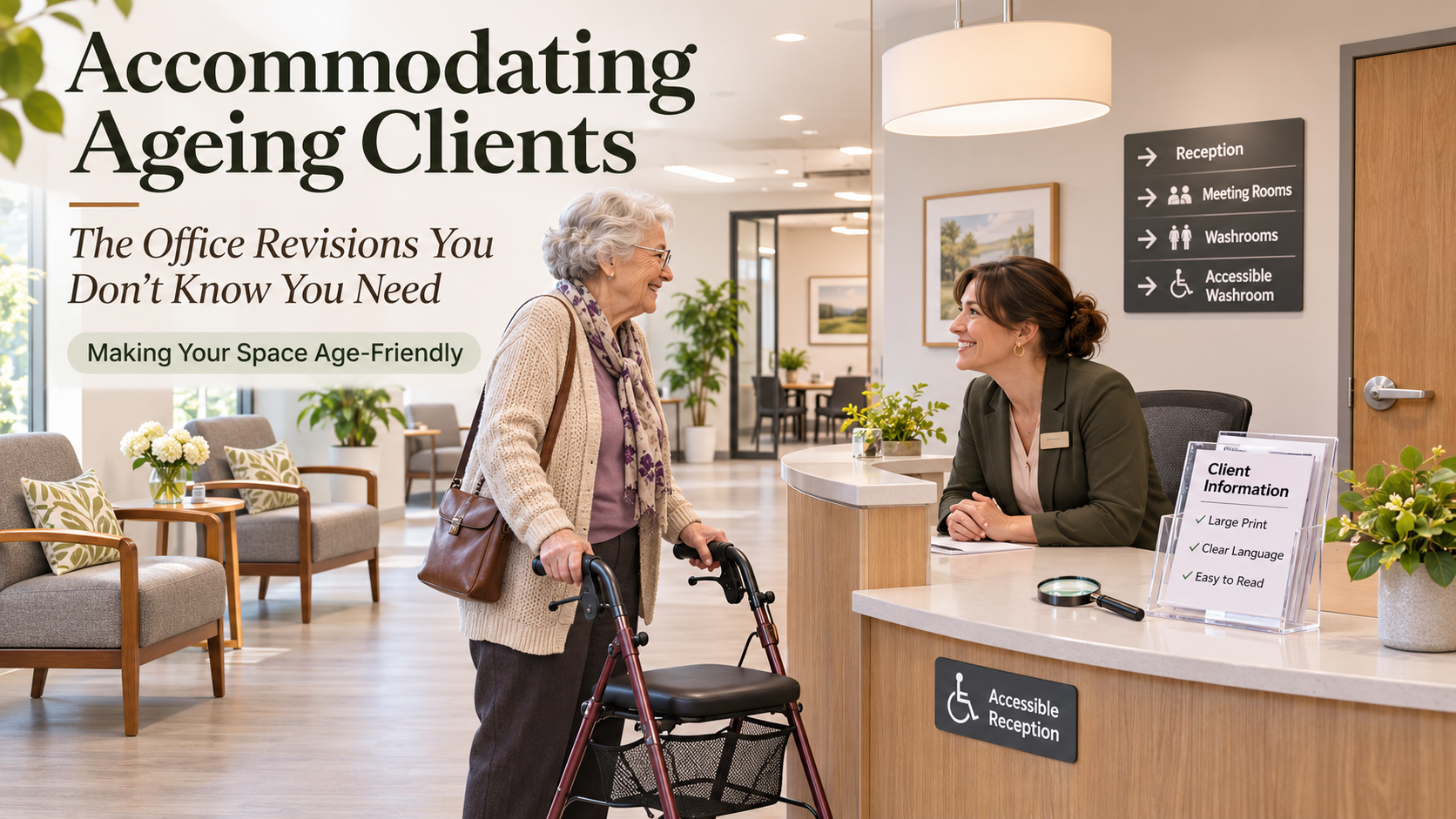
The Office Revisions You Don’t Know You Need
Making Your Space Age-Friendly
Walk into most professional offices and you’ll find a standard setup . . . some seating, glossy floors, decorative plants on stands, and maybe an inviting bowl of tightly wrapped candies at reception. That looks fine, unless you’re managing arthritis or using a wheelchair or a walking aid.
We often say no one should have to work hard to give you their money. Unintentionally, offices can be a dangerous obstacle course for clients.
So, let’s adopt intention.
Start with the Obvious Stuff
The reality: Most office spaces aren’t designed with older clients in mind.
The good news: You don’t need blueprints or a building permit to make the situation better.
Do you understand what’s physically changing for many of your clients as they move through various life stages, and how those changes show up in daily interactions within you and your business space?
A few quick fixes can reduce their frustration, improve comfort, and lower the risk of injury.
Office Design and Layout Should Respect Real Life.
Hearing
Starting as early as our 50s, many of us begin to progressively lose our ability to hear high-frequency sounds. It’s harder to hear certain tones and especially difficult to follow conversations in environments with distracting background noise. Presbycusis refers to age-related hearing loss; it impacts 1 in 3 people by age 65 and 1 in 2 by age 75.
On a personal note, in my late 20s, it was discovered that I had abnormal bone growth in my left middle ear (called otosclerosis) and underwent surgery that helped somewhat. For me, it is not a volume issue, it is an issue of clarity. In noisy environments, I can miss many words because it sounds like people are talking underwater!
Those who watched the first season of CSI on TV will recall the lead character Dr. Gil Grissom had the same issue—his condition was portrayed extremely well.
In certain environments, I need to “lip-read and face-read” to help me grasp the spoken context and to work quickly to replace words that seem garbled!
Suggested Remedies
- Slow your speaking.
- Don’t assume a client’s slow processing of your spoken information means they lack intelligence . . . they may be hearing only every third word and have to scramble to fill in the blanks before they can respond.
- Speak directly to your client, not through their adult child or companion.
- Speak clearly and enunciate well.
- You may need to increase your volume somewhat, but don’t shout!
- Lower the tone of your voice and check to see if that helps
- Establish eye contact and keep your hands away from your face in case the client is lipreading.
- If a client asks you to repeat something, rephrase your sentence.
Sound basic? You bet . . . that’s the point. Simple, practical demonstrations show your clients that their needs are being considered.
Design Your Premises for Bodies That Have Been Around the Block
Arthritis, osteoporosis, and reduced vision aren’t rare exceptions; they are everyday realities for many adults.
- Arthritis is the most common chronic condition among older adults; it impacts fine motor-skills, grip, and mobility.
- Osteoporosis increases the risk of fractures from even minor impacts.
- Presbyopia can occur when our eye lens becomes less flexible; we lose the ability to read fine print and we find our arms are too short to hold printed pages at a readable distance!
You Don’t Need to Turn Your Office into a Clinic.
Just Be Thoughtful and Aware.
A few small changes can make your office a whole lot safer.
- Does your seating consist of low, squishy couches? Be sure to add sturdy chairs with arms and firm seats that support the transference of weight.
- Install lever-style handles instead of knobs.
- Remove area rugs or secure them with anti-slip grips.
- Fix uneven flooring or tricky transitions between surfaces.
- Mark thresholds and stairs with contrasting strips.
- Keep pathways clear of protruding furniture or décor.
- Brighten dark corners, hallways, and stairwells.
- Install grab bars and use nonslip materials in washrooms.
Realistic Remedies for Reading
- On important documents, use a minimum 12-point sans-serif font, such as Arial.
- Have magnifying glasses available for those who need them or people who have forgotten their eyeglasses.
- Increase the lighting by 30%.
- Black words printed on a white background are best; avoid trendy pastels on your print materials and your website.
- Don’t print words on top of pictures. The words and the pictures will be compromised.
- Use large print on your business cards and appointment cards.
- Place taxi or transportation information in plain view.
Give the Senses A Break
You wouldn’t hold a meeting next to an active construction site. Even subtle sensory overload can be distracting and exhausting.
Some clients are negatively sensitive to noise, clutter, and scents. They can affect concentration, comfort, thinking, and mood.
- Keep noise levels low. No background TV or blaring music.
- Avoid strong scents in cleaning products, perfumes, essential oils, and air fresheners.
- Use high-contrast signage and clean, simple fonts.
- Make sure you have CO2 detectors in your office.
Small changes will help your clients feel calm, focused, safe, and welcome.
Let’s Talk Mobility Aids
Wheelchairs, walkers, canes, and crutches aren’t accessories. They are tools necessary for freedom. The presence of mobility aids isn’t the problem. Poor office design is.
Mobility aids are used for many reasons, including joint pain, injury-recovery, balance issues, and longterm conditions. Those aids can help your clients only if your space makes room for them.
- Passageways must be wide-enough for safe movement.
- Offer to help, but always ask before you act.
- Never touch or move someone’s mobility aid without permission.
- Add cane hooks at the reception desk.
- Pull up a chair to have a conversation with a seated person and someone in a wheelchair, so you are at their eye level. Never tower over a person to speak with them . . . perhaps squat to maintain eye contact.
Fall-Prevention Isn’t Just a Safety Thing. It’s a Good Business Decision.
Our balance and reflexes decline gradually. Falls are the #1 cause of injury-related hospitalizations for adults over 65. Many falls happen during normal moments. Even a slight stumble can become serious due to brittle bones from osteoporosis.
My mother once stepped from a carpeted area onto a glossy tile floor, lost her balance, and whiplashed. She didn’t fall—the motion fractured vertebrae in her back. That’s how fragile bodies can be. And how preventable accidents are.
Think About the Whole Appointment Experience, Not Just the Meeting
Your client’s experience doesn’t begin in your office. It starts in the parking lot and ends when they leave your building.
Walking long distances, standing too long, or juggling carried belongings gets harder with age or injury, even if someone “looks fine.”
- Are accessible parking spots nearby?
- Can clients find the entrance without needing to ask?
- Do doors open automatically or does pushing a button open the door? People may be carrying a bag, documents, and a phone while managing a mobility aid.
Every step, from arrival to departure, is part of the appointment with you. Make it a positive experience.
You’ll Get Bonus Points for Thoughtful Preparation
It’s not about being fancy. It’s about being ready.
Small touches communicate that you care before a single word is spoken.
Let Your Office Design Speak Your Concern.
Each client who walks through your door brings a history and expectations. The way your space looks and feels, and the way it is laid out and functions, tells people exactly how much you value them, their time, safety, comfort, and dignity. You don’t need fancy wallpaper, you need thoughtfulness.
- Is there room to move without squeezing past furniture or unstable-but-decorative plant stands?
- If a cane or a crutch snags on an area rug, will the person go flying?
- Is your reception desk designed for seated comfort or simply standing?
And here’s a bonus. Creating an age-friendly environment doesn’t benefit just your maturing clients. It helps everyone. Think of busy parents with kids in strollers, clients on crutches after a sports injury, and your own future self.
A space that works for everyone doesn’t happen by accident. It happens because you decided it should. That’s how you tell someone, “You matter here.” When your space works for a client with a disability, it works better for everyone.
Clients pay attention. Not just to the words and the way you speak, but to how your space makes them feel.
Accommodating all clients isn’t a trend. It’s a smart business decision and a meaningful one. One chap took over his father’s successful and established business, changed the environment to be more age-friendly, and doubled his revenue in a year!
So, the next time you walk into your office, ask yourself . . .
- Would this space make a 72-year-old client feel welcome? Safe? Comfortable? Confident? Respected?
- What about a fit younger adult who injured an ankle skiing and is hobbling on crutches?
Designing for ease, access, safety, and poise doesn’t require a full renovation.
Observe and rethink your environment.
Do you see instant opportunities for improvement?
0 Comments